AI operating model · Organisation design
AI needs a completely new org chart.
Replicating a traditional organisation with agents does not create an AI-native business. It automates the old constraints. The better model is outcome-led, networked and elastic—with human accountability made more explicit, not less.
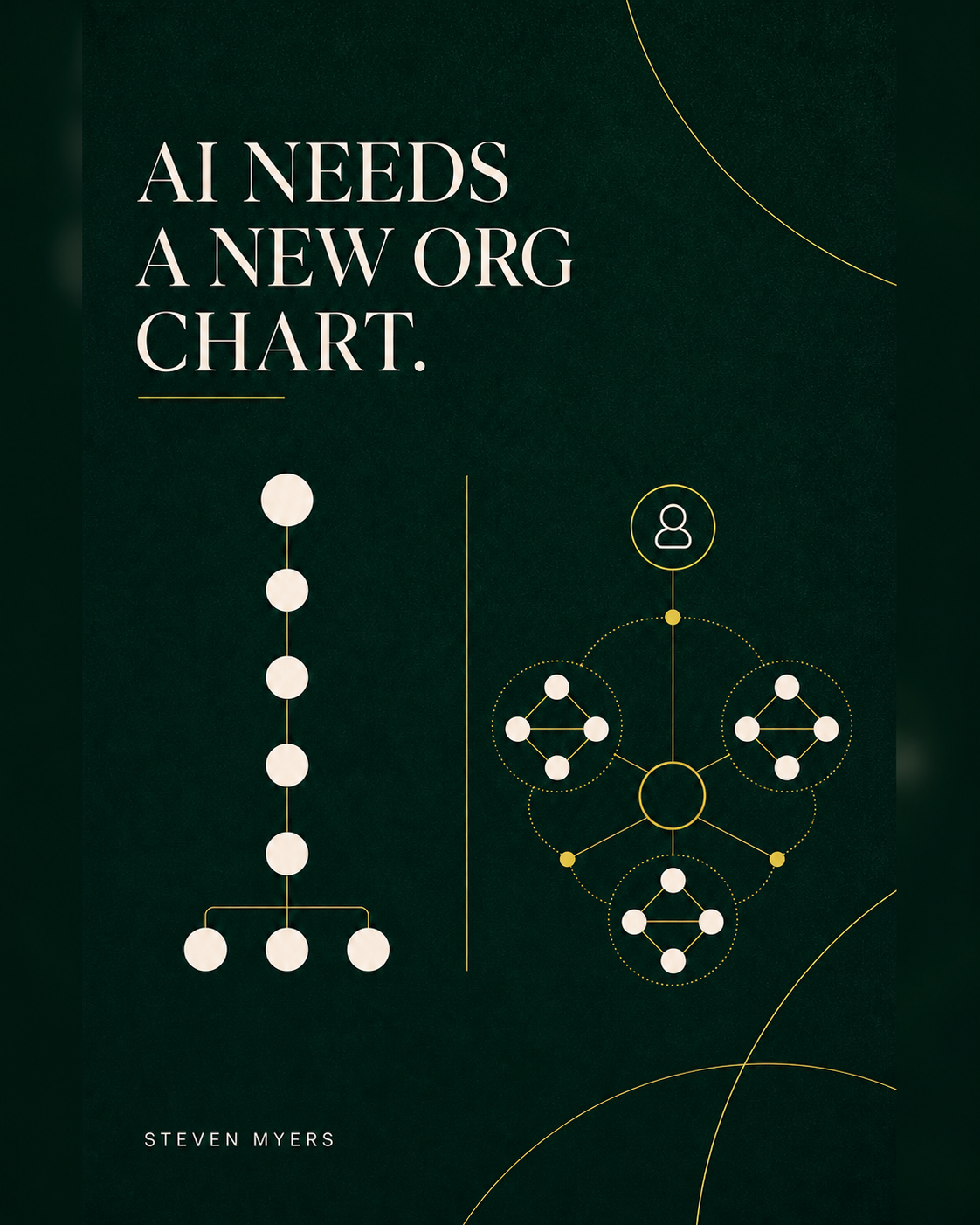
I learned this by trying the opposite. I began by mirroring a traditional organisation with an agentic team. It felt sensible: assign recognisable roles, recreate functions, preserve reporting relationships and automate each box. It worked well enough to reveal why the model was wrong.
Mirroring is a useful prototype because it gives people a familiar place to start. But it is a poor destination. It gives old constraints to a new capability and mistakes faster activity inside each box for a redesigned operating system.
Why replicating the existing org chart fails
It copies the hand-offs
Traditional organisations divide work by function. Research passes to strategy, strategy to delivery, delivery to review, and information is repeatedly condensed and reinterpreted along the way. Mirroring those functions with agents can make each stage faster, but it leaves the sequential flow intact.
The AI-native alternative is an outcome-led pod that brings research, analysis, execution and challenge together around one result. Work can move in parallel, and every contributor sees the same objective, evidence and constraints.
Benefit: fewer resets and a much shorter distance from signal to action.
It preserves hierarchy as the coordination system
Management layers do more than manage people. They route information, reconcile competing priorities and decide what needs attention. That architecture reflects fragmented information and scarce human capacity.
Agents can coordinate against shared context, maintain a visible state of work and escalate exceptions when a threshold is crossed. The human role therefore changes: set the outcome, boundaries, decision rights, evidence standards and risk thresholds—then intervene where judgement is genuinely required.
Benefit: fewer coordination layers, faster decisions and human judgement concentrated where it creates the most value.
It treats roles and capacity as fixed
A traditional job box assumes a scarce person, a defined span of work and a relatively permanent team. Capacity changes slowly because recruitment, onboarding and reorganisation are slow.
Agent capacity is different. Capabilities can be replicated, combined and retired around the work. A team can form for a specific outcome, expand when demand rises and dissolve when the result is achieved. The durable assets are the objective, context, controls, memory and reusable capabilities—not the boxes on a chart.
Benefit: capacity flexes with demand, expertise is reused and cost follows the work more closely.
What an AI-native organisation looks like
The new org chart is less a hierarchy and more an operating network. Its centre is not a function or a seniority level; it is an outcome. Around that outcome sit modular capabilities that can research, create, test, challenge and execute. A shared context layer keeps those capabilities aligned. Human accountability sits above the system as a set of explicit decision rights and guardrails.
Outcomes become the primary unit of design
Start with the result and its economics, not a list of departments.
Agent pods form around the work
Combine the capabilities required for the outcome, then resize them dynamically.
Context is shared infrastructure
Objectives, evidence, state, memory and controls must travel with the work.
Humans govern the boundaries
People own accountability, relationships, trade-offs, risk and irreversible decisions.
A hard reset does not mean “humans out”
Removing hierarchy from routine coordination does not remove human accountability. It makes that accountability more important and more precise. Someone must define what success means, choose the evidence that matters, set limits, resolve ambiguity and accept the consequences of the decision.
The opportunity is to stop spending human attention on routing, reconciliation and status collection when agents can perform those tasks. That attention can move to the work machines cannot legitimately own: judgement under uncertainty, trust, negotiation, ethics, leadership and the irreversible call.
We will not get AI-native performance by drawing digital workers into an analogue chart.
Six questions for leadership teams
- If titles and departments disappeared, which outcomes would organise the business?
- Where do functional hand-offs add the most delay or distortion today?
- Which decisions are reversible, and which require named human accountability?
- What context must every agent and human share to work from the same reality?
- Which capabilities should be reusable and elastic rather than permanently staffed?
- How will cycle time, quality, cost and commercial value be measured together?
Replicating the existing organisation is the intuitive first move. It is also the move most likely to preserve the friction AI should remove. The better starting point is the outcome, the flow of work and the decisions that carry real consequence. Build the organisation from there.
The practical question